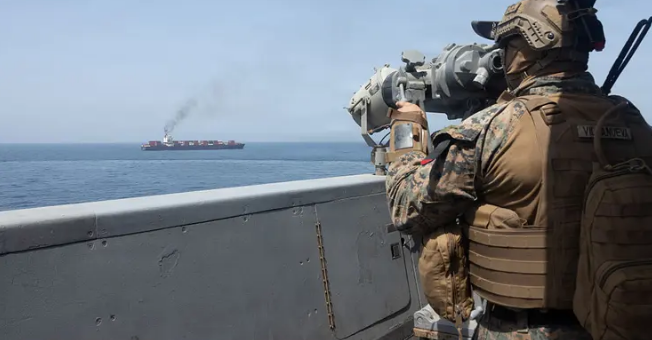
US President Donald Trump has drawn controversy after comparing the US Navy’s actions in the Persian Gulf to piracy, as American forces continue enforcing a sweeping naval blockade on Iranian ports amid an escalating conflict that has disrupted global energy markets.
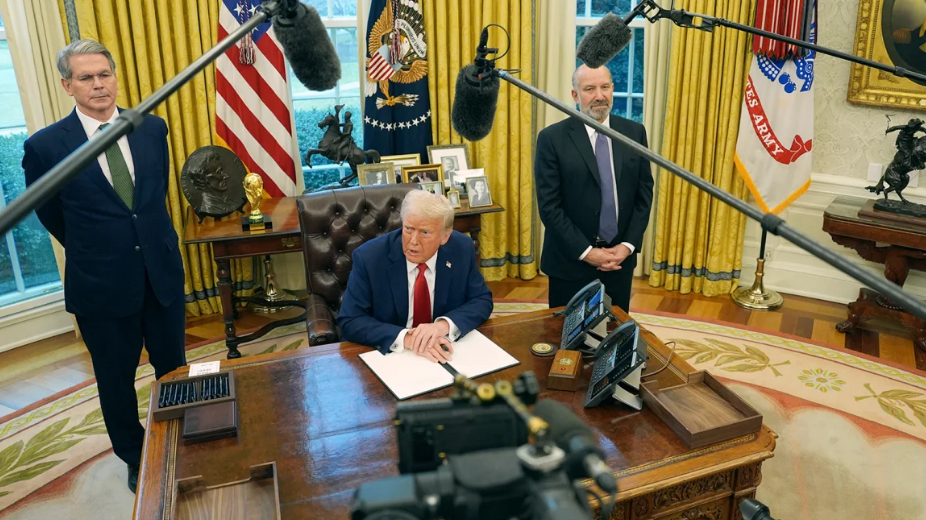
“We took over the ship, we took over the cargo, we took over the oil. It’s a very profitable business,” Trump said on Friday evening while describing a recent seizure of an Iranian-linked vessel. “We’re sort of like pirates, but we are not playing games.”
The remarks come as the United States maintains a naval blockade of Iranian maritime routes, introduced last month following the collapse of peace negotiations between Washington and Tehran. The move followed Iran’s decision to restrict access to the Strait of Hormuz, a vital shipping corridor through which roughly one-fifth of the world’s oil and liquefied natural gas previously passed.
The maritime crisis escalated after a US-Israeli military operation on February 28 triggered a wider conflict, resulting in thousands of civilian casualties. In response, Iran initially closed the strait to commercial traffic before later allowing limited passage for allied and non-combatant nations under a fee-based system.
US authorities say the blockade extends to all vessels attempting to enter or exit the strait if they have paid charges to Iran. According to US Central Command (CENTCOM), American forces have redirected dozens of ships in recent weeks to enforce the restrictions.
Adm. Brad Cooper, CENTCOM commander, said that by late April more than 40 commercial vessels carrying tens of millions of barrels of oil had been turned away. He estimated that Iran had lost more than $6 billion in potential revenue as a result of the disruption. Officials later confirmed that additional vessels have been intercepted, bringing the total number redirected since mid-April to 45.
Trump announced the blockade on social media, stating that US forces would prevent “any and all ships” from entering or leaving the Strait of Hormuz until Iran fully reopened the route to international traffic.
The disruption has had immediate global economic consequences. Oil prices have surged sharply, with fuel costs rising across major economies. In the United States, average gasoline prices reached $4.39 per gallon on Friday, according to AAA data. Aviation fuel costs have also doubled since the conflict began, contributing to financial pressure on airlines.
On Saturday, budget carrier Spirit Airlines became the first US airline to suspend operations, citing unsustainable fuel expenses linked to the crisis.
As tensions continue in the Gulf, the blockade’s economic and geopolitical impact is intensifying, with no immediate resolution in sight.