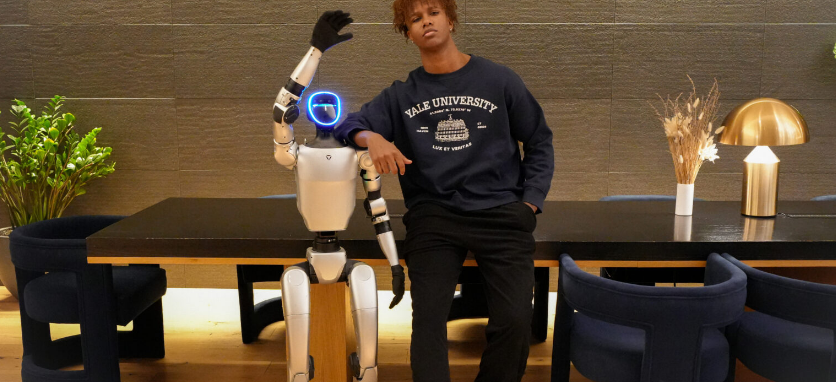
A humanoid robot named Uri made a surprise appearance at Harvard Square and the Harvard vs Brown football game last week, capturing the attention of students and fans while generating over one million social media views in just 24 hours.
Uri, a Unitree G1 humanoid robot with advanced movement and artificial intelligence, has been appointed as the chief marketing officer of Series, a new student-focused social networking platform. The move, which the company calls both cost-efficient and disruptive, is part of a wider campaign to position itself as a challenger in the crowded social media space.
“Most CMOs cost $100,000–$300,000 a year. Ours is a fraction of that, and it gains more attention than most celebrities do in any given room,” said Nathaneo Johnson, Series’ CEO and co-founder. “That’s marketing.”
During its debut campaign, Uri unveiled a 12-by-8-foot banner featuring Harvard students, handed out free matcha drinks, and acted as a photo magnet in Harvard Square, becoming one of the most discussed campus activations of the season.
The robot is more than a stunt, according to Series. Equipped with 43 degrees of freedom, 3D LiDAR sensors, depth cameras and reinforcement learning, Uri is capable of real-time speech, natural movement and adaptive engagement. These features allow it to interact directly with students and Series users, blending human-like social interaction with the company’s vision of tech-driven connection.
The strategy marks a new frontier in marketing and leadership roles, with Uri serving not only as a campaign mascot but also as a symbol of the company’s ambition to integrate robotics and AI into everyday student networking. “This move reflects our belief that robotics and AI will co-create the future of connection,” Johnson said. “Uri’s capabilities are far beyond novelty — it’s about setting a culture of constant innovation.”
Since its launch, Series has facilitated more than 700,000 student messages, boasting a 95% acceptance rate on match suggestions. The app’s goal is to strengthen student communities by matching peers based on shared academic, cultural and social interests.
Uri’s Harvard campaign is just the start. The robot is scheduled to headline a Series College Tour, with upcoming appearances at universities across the United States. Each stop is expected to combine live student engagement with viral marketing, positioning Series as a platform that mixes digital networking with face-to-face experiences.
As the social app grows and Uri takes on more campus campaigns, the experiment raises a broader question: can a humanoid robot effectively drive brand identity and foster human connection in spaces traditionally shaped by people? For now, Series is betting that it can — and students appear eager to join the conversation.