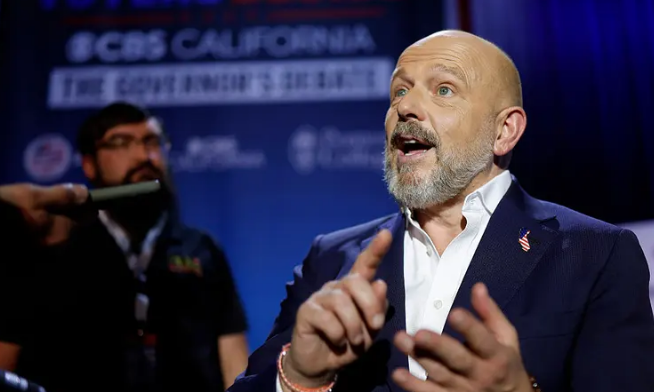
President Donald Trump’s political instincts have often favoured outspoken, outsider candidates, and his backing of former adviser Steve Hilton has added an unexpected dynamic to the race for California governor, a contest already marked by shifting alliances and voter dissatisfaction with long-standing Democratic control.
Hilton, a British-born former strategist for Margaret Thatcher’s political circle and later an adviser to former UK Prime Minister David Cameron, has positioned himself as a reform-minded Republican seeking to challenge nearly two decades of Democratic dominance in the state. A dual UK-US citizen since 2021, he has also worked as a Fox News commentator, building a profile that blends media presence with political consultancy.
California’s top-two primary system means all candidates compete on a single ballot, with the two highest vote-getters advancing to the general election regardless of party. That structure has given Hilton a pathway into contention, despite California’s strong Democratic lean, where Kamala Harris previously won the state by a wide margin over Trump.
Speaking this week, Hilton said growing voter frustration is driving momentum behind his campaign. He argued that California has been under one-party control for years, describing the results as disappointing across key areas including housing, public safety and economic management. He pointed to public sentiment suggesting the state is heading in the wrong direction and faces economic uncertainty.
Hilton has attempted to distinguish himself from more polarising Republican figures by emphasising pragmatic governance and a willingness to work within California’s Democratic-led legislature. His campaign focuses on reducing living costs, cutting taxes for lower income brackets and businesses, and lowering energy prices. He has branded his policy programme “Californable,” presenting it as a plan to make the state more affordable and efficient.
His proposals include exempting the first portion of income from state tax, reducing electricity costs, and lowering fuel prices, largely through restructuring regulations tied to environmental and administrative policy. Critics, however, question the feasibility of such measures given the scale of the state budget and entrenched political opposition in Sacramento.
Hilton has acknowledged that, if elected, he would face a legislature controlled by Democrats. Rather than attempting sweeping structural change, he said he would use executive authority over appointments and regulatory agencies to influence policy direction. He also suggested that veto powers could be used strategically to force lawmakers to publicly defend their positions.
The race has been shaped by a fragmented field, with Democratic candidates dividing support and several high-profile contenders facing setbacks. That division has contributed to Hilton’s visibility in what is otherwise a heavily Democratic state.
Polling data indicates widespread concern among Californians about cost of living pressures, housing affordability and public safety. Hilton has sought to align his campaign with those concerns, arguing that reform is necessary to restore confidence in state governance.
The contest will ultimately be decided in the upcoming primary round, where Hilton must secure enough support to advance to the general election. If successful, he would face the challenge of translating a reform-focused platform into action within a political system still firmly controlled by Democrats.