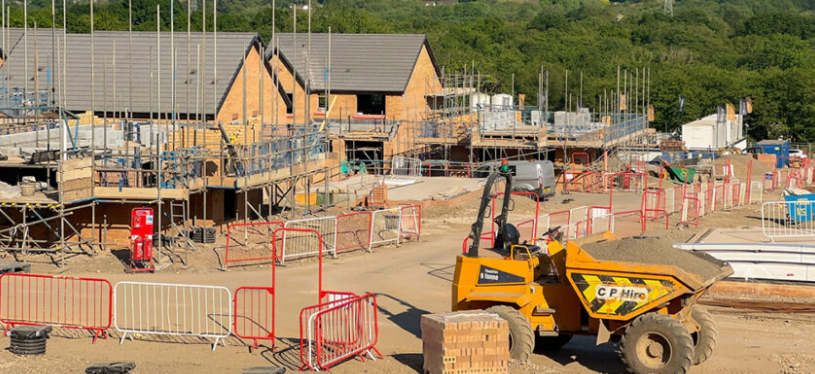
UK housebuilding has dropped to its weakest level since the Covid-19 lockdowns, highlighting the challenges facing ministers as they try to boost construction and meet housing targets. New figures from S&P Global show that activity across the construction sector continued to shrink in December, with housing and commercial projects declining at their fastest pace in over four years.
The survey of purchasing managers revealed that both housebuilding and commercial construction fell at their sharpest rate since May 2020, when building sites were closed during the first national lockdown. Civil engineering activity also declined, though at a slower rate than in November.
The UK construction Purchasing Managers’ Index (PMI) rose slightly to 40.1 in December from 39.4 the previous month. While the increase shows some moderation, it remains well below the 50 mark that separates growth from contraction, indicating continued weakness in the sector.
The downturn has now lasted 12 consecutive months, marking the longest continuous period of contraction in the UK construction industry since the 2007–09 global financial crisis. S&P Global said fragile client confidence and delayed investment decisions, particularly in the run-up to November’s Budget, continued to weigh heavily on workloads. Although some uncertainty has eased since the Budget, weak order books are still affecting firms.
Tim Moore, economics director at S&P Global Market Intelligence, said, “UK construction companies once again reported challenging business conditions and falling workloads in December, but the speed of the downturn moderated from the five-and-a-half-year record seen in November. Many firms cited subdued demand and fragile client confidence. Despite a lifting of Budget-related uncertainty, delayed spending decisions were still contributing to weak sales pipelines at the close of the year.”
The data shows that housing and commercial construction experienced the fastest reductions in activity, while civil engineering saw a slower pace of decline. There were, however, tentative signs of stabilisation. Business expectations for the year ahead rose to a five-month high in December, suggesting that confidence may be starting to recover as policy clarity improves.
The decline raises concerns over the government’s ambition to accelerate housebuilding and expand social housing. High interest rates, weak developer confidence, and limited investment continue to impede new projects, leaving ministers facing a tough path to achieving their housing targets.
The figures underscore the scale of the challenge in revitalising the UK construction sector, as policymakers balance the need for more homes with the economic pressures weighing on the industry.