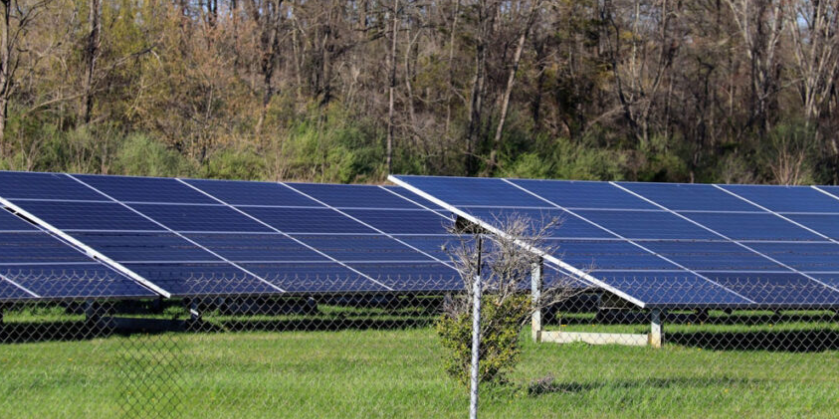
A new report from countryside charity CPRE has revealed that nearly two-thirds of England’s largest solar farms have been built on productive agricultural land, sparking concerns over food security and the future of rural landscapes.
According to CPRE’s analysis of 38 industrial-scale solar farms — each generating over 30 megawatts — 59% are located on farmland, with a third of that land classified as Grade 1 to 3a, officially deemed the “best and most versatile” (BMV) for growing food. In total, 827 hectares of prime agricultural land have been removed from food production, equivalent to approximately 1,300 football pitches.
The report highlights three solar farms — at Sutton Bridge in Lincolnshire, Goosehall in East Cambridgeshire, and Black Peak Farm in South Cambridgeshire — that are sited entirely on BMV land, despite planning policies intended to protect such areas.
CPRE is calling on the government to take urgent action to redirect solar development away from green fields and toward more sustainable alternatives such as rooftops, car parks, and brownfield sites.
“This isn’t just about protecting our countryside,” said Jackie Copley, CPRE’s campaigns lead and author of the report. “It’s about smart energy planning that brings people together around practical solutions that work for everyone.”
The findings come as the UK works to meet ambitious government targets to expand solar capacity from the current 16.6 gigawatts (GW) to 45–47 GW by 2030. CPRE warns that if the current approach continues, up to 65% of new solar installations could be ground-mounted — putting thousands more hectares of agricultural land at risk.
In addition to concerns over food resilience, the charity warns that overreliance on greenfield development could deepen rural opposition to clean energy projects. Instead, CPRE argues, focusing on existing structures such as warehouses, supermarkets, and public buildings could provide up to 117 GW of solar capacity by 2050 — well above national targets.
The group is urging ministers to set a formal target for 60% of future solar development to come from rooftops and brownfield sites, and to ban solar farms entirely on Grades 1 and 2 farmland.
The report also highlights stark regional disparities in solar deployment. In Sleaford and North Hykeham, Lincolnshire, solar farms now cover 7% of the land — nearly 20 times the national average projection of 0.4%.
While CPRE welcomed the government’s recent Solar Roadmap and its proposals to increase rooftop installations, it says current plans fall short of what’s needed to avoid long-term land-use conflict.
“The government must do more — and faster — to unlock the vast untapped potential of rooftop solar,” said Copley. “By focusing on existing buildings instead of productive fields, we can decarbonise the grid, safeguard food production, and avoid pitting clean energy against rural communities.”