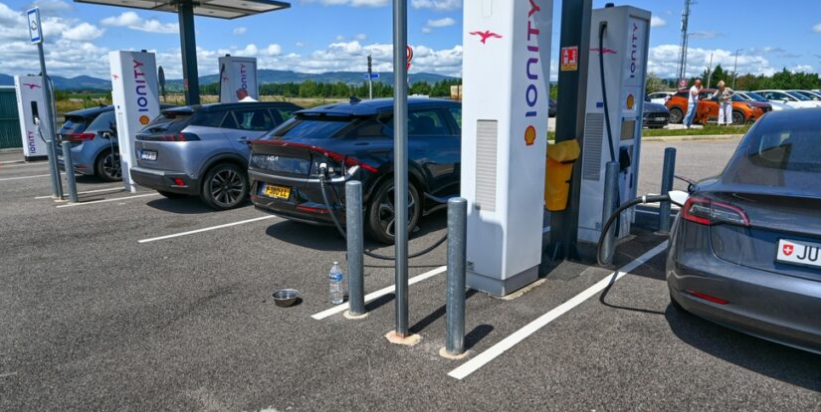
The Labour government has scrapped the Conservatives’ £950 million Rapid Charging Fund (RCF), redirecting a reduced £400 million investment toward on-street electric vehicle (EV) charging points, particularly in lower-income and underserved urban communities.
Originally introduced in 2020 by then-chancellor Rishi Sunak, the RCF aimed to expand rapid charging infrastructure at motorway service areas by funding necessary grid upgrades. However, the Department for Transport has now confirmed that the fund was never formally included in budgeted spending plans and had stalled over concerns about poor design and the risk of disproportionately favouring certain service station operators.
In a shift of priorities, Chancellor Rachel Reeves announced the new £400 million commitment as part of the latest spending review, building on a previous £200 million pledge made in the autumn budget. The revised strategy aims to fill charging gaps in residential neighbourhoods where the private sector has been slower to invest due to lower profit margins.
A Department for Transport spokesperson explained: “Since the fund was announced in 2020, the market has changed significantly. The rapid charging fund was designed to support motorway charging, but detailed plans were never delivered by the previous government.”
Indeed, the UK’s charging infrastructure has expanded rapidly. According to Zap Map, the number of public rapid and ultra-rapid chargers near major roads has nearly quadrupled in the past three years, and there are now over 80,000 public charging points across the UK—a 29% year-on-year increase.
Still, the decision to downscale the funding has drawn mixed reactions. John Lewis, CEO of on-street charging firm char.gy, welcomed the renewed focus on urban infrastructure but questioned why the full £950 million was not reallocated to support broader EV adoption. “This is a positive step, but couldn’t the full amount have been redirected to boost confidence in the switch to electric?” he asked.
Industry leaders like Ian Johnston, CEO of Osprey Charging, have urged the government to take a more strategic approach. He recommended targeting funding at areas with high grid connection costs and called for regulatory changes to improve road signage for charge points.
Quentin Willson, founder of EV advocacy group FairCharge, was more critical, warning that withholding the unspent RCF funds could undermine public trust in the government’s commitment to net zero. “It opens them to obvious questions about their seriousness on the EV transition,” he said, while also renewing calls for VAT on public charging to be lowered from 20% to the 5% home electricity rate.
Despite criticism, the government maintains the revised plan reflects current infrastructure needs. Ministers argue that urban, on-street access is the most pressing challenge, especially for households without private parking—an equity issue they say must be prioritised to support wider EV adoption.
With the UK’s net zero targets looming and regional disparities in EV uptake persisting, pressure is mounting on the government to ensure that funding cuts do not stall progress on clean transport.