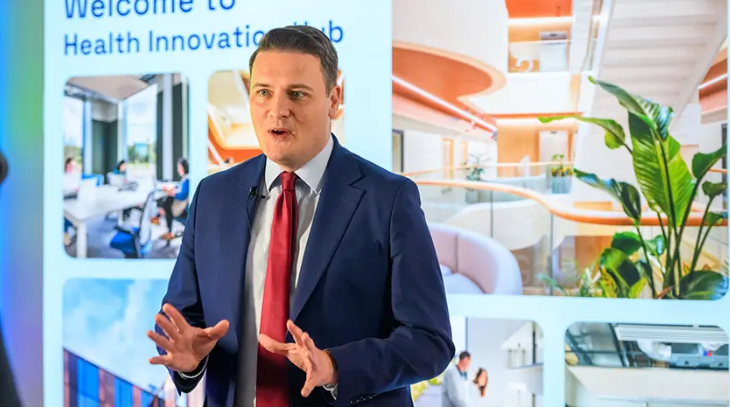
Glasgow has officially opened a landmark life sciences facility, marking a significant milestone for Scotland’s growing healthcare innovation sector. The 87,000 sq ft Health Innovation Hub (HiH) was inaugurated on 5 March by Wes Streeting, highlighting the city’s ambition to become a leading centre for biomedical research, digital health, and precision medicine.
The hub, developed by Kadans Science Partner in collaboration with the University of Glasgow and its Living Laboratory for Precision Medicine, transforms a former brownfield site into a state-of-the-art research and commercialisation facility. It forms a key part of the Glasgow Riverside Innovation District (GRID), an initiative designed to attract investment, support high-growth life sciences companies, and strengthen partnerships between academia, the NHS, and industry.
The project received £18.8 million in funding from UK Research and Innovation through its Strength in Places Fund, alongside support from the Glasgow City Region City Deal, which will invest £1 billion in infrastructure and economic growth across the region. These combined investments aim to position Glasgow as a hub for translational medicine, enabling faster application of scientific discoveries into clinical practice.
Speaking at the launch, Streeting called the life sciences sector one of the UK’s “greatest national assets” and described facilities like the HiH as “jewels in the crown.” He highlighted the country’s leadership in areas such as vaccine development and said the new hub would ensure Scotland and the UK remain at the forefront of precision medicine.
A major advantage of the facility is its proximity to the Queen Elizabeth University Hospital, one of the largest in Europe. This allows researchers and companies to operate within Glasgow’s Clinical Innovation Zone, collaborating directly with clinicians, patients, and healthcare data systems. The hub brings together academic researchers, NHS staff, biotechnology firms, and digital health companies, aiming to accelerate the development of new diagnostics, therapies, and healthcare technologies.
The building is already more than 70% occupied, with early tenants including Chemify, Panthera, and Genetix Research Ltd. It also houses the Digital Health Validation Lab, a partnership between the University of Glasgow and NHS Greater Glasgow and Clyde, where new healthcare technologies can be tested in real clinical workflows.
Kadans Science Partner CEO Steijn Ribbens said the hub reflects the impact of long-term public-private collaboration. “The building is the embodiment of what can be achieved when universities, industry, healthcare providers and government partners work together,” he said.
Local leaders emphasised the hub’s economic and community benefits. Glasgow City Council leader Susan Aitken said it would create skilled jobs, provide new career pathways, and contribute to regeneration in Govan and surrounding areas. The development, which achieved BREEAM Excellent certification, also incorporates sustainable design and energy-efficient infrastructure.
Professor Andy Schofield, vice-chancellor of the University of Glasgow, said the hub offers an environment where discoveries can move rapidly into patient care. The facility is expected to play a central role in advancing precision medicine, digital healthcare technologies, and biomedical research, reinforcing Glasgow’s position as one of the UK’s key life sciences clusters.