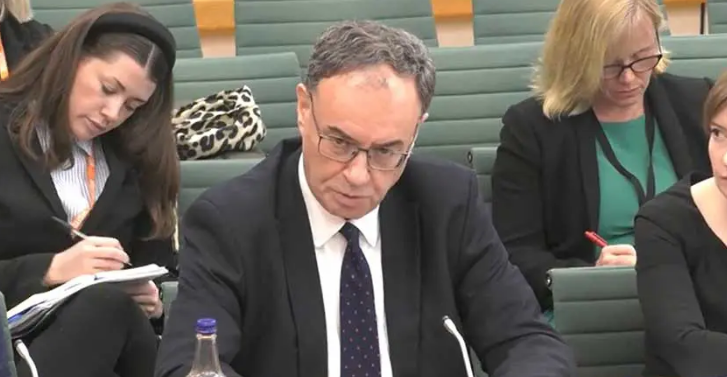
Businesses hoping for lower borrowing costs may have to wait longer after Bank of England Governor Andrew Bailey indicated that interest rate cuts are not currently being considered, citing inflation risks linked to geopolitical tensions and rising energy prices.
Speaking at the European Central Bank’s annual forum in Sintra, Portugal, Bailey said expectations for rate reductions that had emerged earlier this year have faded as policymakers focus on the economic impact of the conflict involving Iran and its effect on global energy markets.
“There was an expectation that we would cut rates this year. That was off the table in March, and it’s off the table at the moment,” Bailey said.
His remarks suggest the Bank of England is likely to leave its benchmark interest rate unchanged when the Monetary Policy Committee meets on July 30. Financial markets now expect Bank Rate to remain at 3.75% for the rest of the year, meaning borrowing costs for households and businesses are likely to stay elevated.
Bailey stressed that the Bank’s position should not be interpreted as a move toward tighter monetary policy. Instead, he pointed to signs that the UK economy and labour market are losing momentum.
“We’ve got a softening economy, so we’re seeing a softening labour market, we’re seeing some softening of activity,” he said, adding that these trends were already evident before tensions in the Gulf intensified.
The Bank faces a difficult balancing act. While weaker economic activity would normally support lower interest rates to stimulate growth, higher oil and gas prices threaten to push inflation upward, making policymakers reluctant to ease borrowing costs too soon.
At its June 18 meeting, the Monetary Policy Committee voted 7-2 to keep interest rates unchanged at 3.75%. Bailey said committee members will reassess the latest economic data when they meet again later this month.
A major concern for policymakers is the possibility that higher energy prices could spread into other parts of the economy. Bailey said the Bank is closely monitoring whether rising fuel costs feed into food prices, wages and broader inflation.
“We’re very focused on the risks of pass-through of the energy prices to indirect effects and the second-round effects,” he said. “We obviously don’t want inflation to become embedded.”
UK inflation stood at 2.8% in May, close to the Bank’s 2% target. However, economists expect inflation to rise again later this year as higher energy costs filter through the economy.
The impact may be delayed because Britain’s household energy price cap is adjusted every three months. Energy regulator Ofgem increased the annual household price cap by £221 to £1,862 from July 1, with the higher rates remaining in place until the end of September.
For businesses, particularly small and medium-sized enterprises, the Bank’s latest stance means financing costs are likely to remain high while energy bills continue to increase. Companies that had anticipated lower interest rates to ease borrowing expenses may now need to revise their financial plans as policymakers continue to prioritize controlling inflation over supporting cheaper credit.