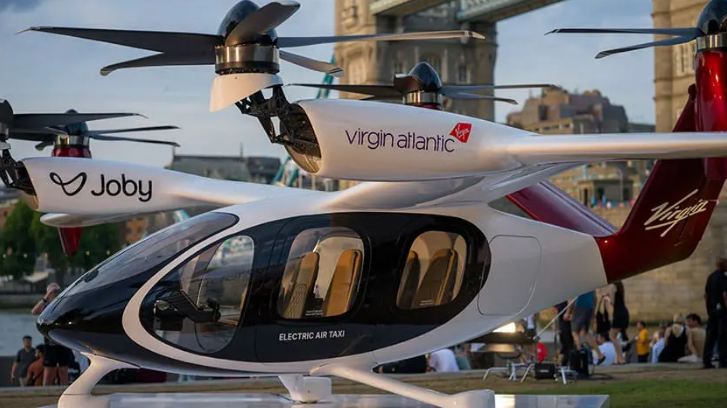
Virgin Atlantic and Joby Aviation have signed a binding multi-year agreement to bring electric air taxi services to the UK, promising rapid connections between major airports and nearby cities.
The deal, announced at the Farnborough International Airshow, gives Virgin Atlantic exclusive airline partner status for Joby’s UK air taxi service. It turns a partnership first announced in 2025 into a commercial framework.
The companies are promoting journeys that could take about eight minutes between Heathrow and central London, while a trip from Manchester Airport to Leeds could take around 15 minutes.
Virgin Atlantic will sell Joby’s air taxi service through its website and mobile app, allowing passengers to book a connection alongside a long-haul flight. London and Manchester will serve as the initial hubs, with Manchester expected to support links across northern England.
“This agreement marks an exciting next chapter in our partnership with Joby and a significant step towards bringing electric air taxi services to the UK,” said Corneel Koster, chief executive of Virgin Atlantic.
Virgin Atlantic’s partnership with Joby is also supported by the company’s relationship with Delta Air Lines, which owns a 49 per cent stake in Virgin Atlantic.
Joby founder and chief executive JoeBen Bevirt said the UK was one of the most promising markets for electric air taxi technology and that the partnership could create significant opportunities as services are introduced in major cities.
The company is developing aircraft equipped with six tilting propellers that can take off and land vertically. The aircraft are designed to carry passengers on routes of up to 100 miles and produce significantly less noise than helicopters.
However, the launch of commercial services depends on regulatory approval. Joby will remain responsible for aircraft operations and route management, while the company must secure approvals from the UK’s Civil Aviation Authority.
The CAA is working towards establishing a regulatory framework for commercial passenger electric vertical take-off and landing aircraft by the end of 2028. The rules will cover areas including airworthiness, pilot licensing and vertiport design.
Joby’s aircraft certification is progressing under a safety agreement between the US Federal Aviation Administration and the CAA.
The agreement comes as competition in Britain’s emerging advanced air mobility sector grows. Vertical Aerospace, a UK-based company, recently confirmed plans to manufacture its own electric aircraft in Britain after receiving additional government funding.
The wider industry is also attracting public investment. The UK Government has committed £46.5 million to accelerate the development of drones and flying taxis, including £26.5 million through the CAA.
Infrastructure will be central to the sector’s expansion, requiring vertiports, charging systems, maintenance facilities, security and ground-handling services.
The deal between Virgin Atlantic and Joby signals that the race to establish electric air taxi services is increasingly focused not only on aircraft development, but also on securing customers, booking platforms and the infrastructure needed to support commercial operations.