The UK government is considering lowering the operating speed of HS2 trains as part of an effort to contain costs and avoid further delays on the high-speed rail project. Ministers are expected to instruct HS2 Ltd to assess the feasibility of running trains below the originally planned top speed of 360km/h (224mph) on the London–Birmingham route, a move that could save billions but would reduce one of the scheme’s defining features.
The proposal is part of a broader review led by Transport Secretary Heidi Alexander, who is exploring options to bring the project back under control after years of cost overruns and delays. HS2’s total cost is now projected to exceed £100 billion in today’s prices, with the initial London–Birmingham phase likely to be completed later than the current 2033 target.
A long-awaited “reset” plan, being developed by HS2 chief executive Mark Wild, is expected to set out a revised timetable and budget. Wild, who previously led the Crossrail project, was appointed to stabilise the programme after the government described the scheme as “an appalling mess.” The plan’s publication has been delayed until after the May elections.
HS2 was originally designed as one of the fastest conventional railways in the world, with a maximum speed of 360km/h. Achieving and validating those speeds, however, presents significant technical and financial challenges. Testing trains at full speed would require a dedicated test track or a fully completed railway, both of which could add years to the project and increase costs. Officials are also considering testing trains overseas, including in China, where high-speed infrastructure is already in place.
Lowering the initial operating speed could simplify testing, reduce engineering complexity, and accelerate delivery, but it would come at the expense of the headline journey times that have defined HS2’s ambition. For context, most UK rail services operate at speeds up to 200km/h (125mph), while HS1, the Channel Tunnel route, reaches 300km/h.
The potential change highlights the tension between HS2’s performance ambitions and fiscal realities. While the project was intended to transform travel between London, Birmingham, Manchester, and Leeds, the northern legs to Leeds and beyond have been scrapped, scaling back its original vision. Under current plans, trains will continue north from Birmingham to Manchester using the West Coast Main Line, operating at lower speeds than on the purpose-built HS2 track.
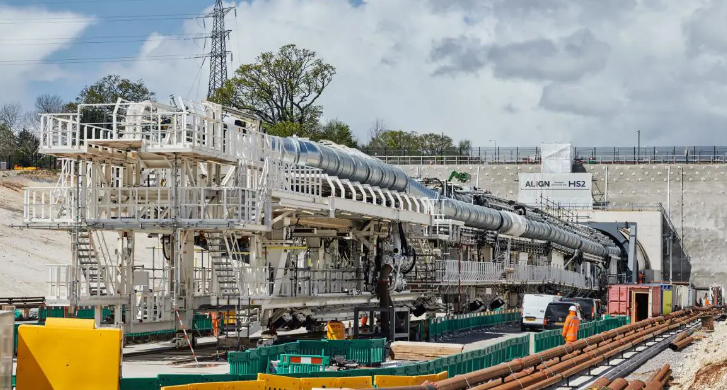
Critics warn that reducing train speeds could undermine the project’s value proposition, while supporters argue that pragmatic adjustments are necessary to ensure completion. Major construction milestones, including tunnels, viaducts, and earthworks, continue along the route, even as the project remains years from becoming operational.
Lowering train speeds, while politically sensitive, is emerging as one of several options being considered to bring HS2 back on track. Whether the compromise will satisfy stakeholders depends on balancing cost savings with the original promise of a world-class high-speed railway, a question that is likely to define HS2’s next phase.