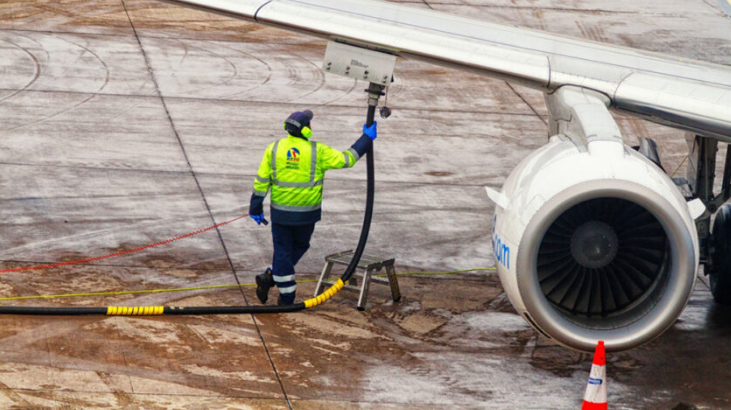
British businesses are facing mounting pressure from soaring travel costs and potential supply chain disruption, as a deepening jet fuel shortage linked to the prolonged closure of the Strait of Hormuz raises the risk of rationing in the United Kingdom, according to a new assessment by Goldman Sachs.
The Wall Street bank warned that commercial fuel inventories in the UK could fall to critically low levels within weeks, placing airlines, freight operators and export-reliant small businesses under significant strain. The report identifies Britain as the most exposed European economy due to limited reserves, high import dependence, and reduced domestic refining capacity.
Goldman Sachs analysts said the UK has “no strategic reserves” of jet fuel, leaving it reliant on commercial stocks as its main buffer. That vulnerability, they noted, is now being tested by a global supply shock triggered by the ongoing conflict in the Middle East and the closure of a key shipping route through the Strait of Hormuz.
Jet fuel prices have doubled since late February, when hostilities escalated. Airlines have already reduced global capacity by around two million seats in recent weeks, while rising fuel costs are being passed on to consumers through higher fares and freight charges.
Major carriers have begun adjusting operations. IAG, owner of British Airways, confirmed it would pass on higher fuel costs, while Air France expects an additional $2.4 billion in fuel expenses. American Airlines has forecast an extra $4 billion burden, both signalling further ticket price increases and cost-cutting measures.
Ryanair chief executive Michael O’Leary said European airlines are preparing to cancel routes as fuel availability tightens, warning that reductions could begin within weeks. Industry suppliers have also cautioned that the UK has “limited visibility” on future fuel supply, reflecting its reliance on imported energy from volatile regions.
The UK government has insisted alternative supply routes can be secured, but structural concerns have been highlighted by the closure of the Grangemouth refinery in 2025, which significantly reduced domestic refining capacity.
Prime Minister Sir Keir Starmer acknowledged that the crisis could affect holiday travel patterns, an admission that has unsettled the tourism and export sectors. Many small businesses depend on passenger flights for both cargo capacity and access to overseas markets.
Across Europe, the European Commission is preparing emergency guidance for airlines as competition for fuel intensifies. With Gulf supplies disrupted, carriers are increasingly sourcing jet fuel from Asia and the United States, driving prices higher.
Fuel suppliers estimate that conditions may remain stable in the short term, but warn that disruptions could emerge by mid-to-late June if the Strait of Hormuz remains closed, placing peak summer travel and trade operations at risk.
For UK businesses, the outlook points to higher costs, tighter capacity, and growing uncertainty across aviation-dependent sectors.