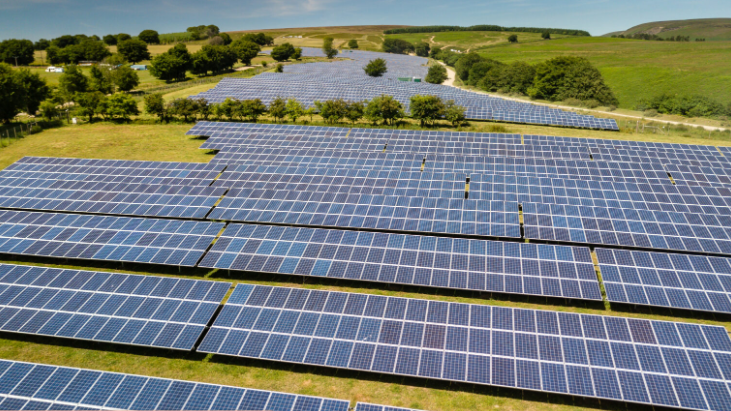
Britain’s solar sector delivered a statement of intent this week, smashing generation records on consecutive days as the government approved one of the country’s largest solar installations.
Solar farms across England, Wales and Scotland generated 14.1 gigawatts of electricity at midday on Monday, surpassing the previous record of 14GW set last July. The milestone was short-lived, with output climbing even higher to 14.4GW on Tuesday afternoon, setting a new benchmark for solar energy production in the UK.
The record-breaking performance coincided with government approval for the Springwell solar farm in Lincolnshire. The project is expected to generate enough electricity at peak capacity to power around 180,000 homes. Energy Minister Michael Shanks described the development as a key step in reducing reliance on volatile global fossil fuel markets, saying solar power is now among the most affordable sources of energy available.
Springwell follows the earlier approval of the Tillbridge solar project, also located in Lincolnshire, highlighting a growing focus on large-scale renewable developments in the region. Both projects form part of a broader pipeline of clean energy initiatives introduced since the Labour government took office in 2024. Officials say the combined output of these projects, along with more than 20 others approved in the same period, could supply electricity equivalent to the needs of up to 12.5 million homes.
The surge in solar generation comes shortly after wind power also reached record levels, with output peaking at 23.9GW. Increased renewable production has contributed to a reduction in gas-fired electricity generation, which has fallen to its lowest level in two years. The electricity system operator is now preparing to test running the grid without gas generation for short periods as early as this summer.
The government has introduced measures aimed at accelerating the adoption of solar energy. Planning rules for smaller “plug-in” solar installations have been simplified, and new building standards will require solar panels on all newly constructed homes from 2028. These changes are expected to gradually lower energy costs for households and businesses, particularly those operating from newer properties.
For businesses facing rising energy bills, the expansion of renewable energy offers the prospect of more stable pricing in the future. However, questions remain over whether the pace of development will be sufficient to deliver the cost reductions promised by policymakers.
With generation records continuing to be broken and new projects gaining approval, the UK’s transition toward a low-carbon electricity system is gaining momentum, even as challenges around scale and speed persist.