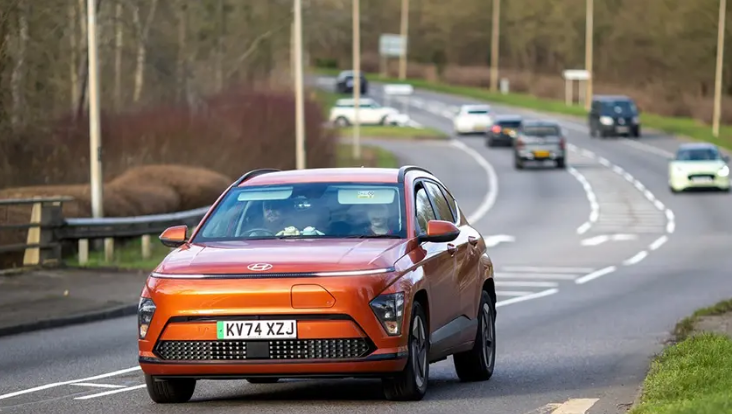
New car sales in the United Kingdom reached their highest February levels in over 20 years, as the automotive market shows strong signs of recovery. Data from the Society of Motor Manufacturers and Traders (SMMT) revealed that more than 90,000 new vehicles were registered last month, marking the strongest February performance since 2004. Analysts attribute the rebound to improved supply chains, rising consumer demand, and dealer incentives after years of disruption in the sector.
Despite the overall growth, the transition to battery electric vehicles (BEVs) has slowed. Just over 21,800 fully electric cars were registered in February, a year-on-year increase of 2.8 per cent, or 596 vehicles. Because total car sales grew faster, the market share of electric vehicles fell to 24.2 per cent, down from 25.3 per cent in February 2025. This marks the second consecutive monthly decline in EV market share and raises concerns over the pace of the UK’s shift away from petrol and diesel.
The UK government’s Zero Emission Vehicle (ZEV) mandate aims for roughly one-third of new car sales to be electric by the mid-2020s. Industry leaders warn that current adoption rates remain below the levels needed to meet that target. Mike Hawes, chief executive of the SMMT, said the figures show a recovering car market but a slower-than-expected electric transition. He urged policymakers to review the ZEV mandate and consumer incentives to close the gap between current demand and government targets.
Several factors continue to slow EV uptake. Electric vehicles still carry a price premium compared with petrol models, and many households face practical challenges related to charging infrastructure, particularly in rural areas and for residents without off-street parking. Renters and flat owners are especially affected, as installing home charge points can be difficult.
Supporters of the electric transition say government incentives and infrastructure investment are beginning to address these barriers. Susan Wells, director of EV and solar at Hive, said that February’s figures remain a positive signal for long-term adoption. She highlighted recent government measures to expand EV charge point grants, noting that such initiatives could support households without driveways or access to home charging.
The strong sales figures reflect broader recovery in the UK automotive market after several challenging years. Pandemic disruptions, semiconductor shortages, and supply chain bottlenecks had constrained production and limited vehicle availability. Improved supply in early 2026 allowed manufacturers to deliver delayed orders and restock showrooms, while promotional finance offers and dealer discounts helped boost demand.
Analysts expect electric vehicles to continue gaining ground over the coming years, as automakers invest heavily in new models and battery costs fall with global production scale-up. The UK government also plans to phase out petrol and diesel car sales by 2030, reinforcing the long-term shift toward zero-emission vehicles. For now, February’s figures highlight a paradox: the UK car market is growing strongly, but the transition to electric mobility is progressing more slowly than planned.