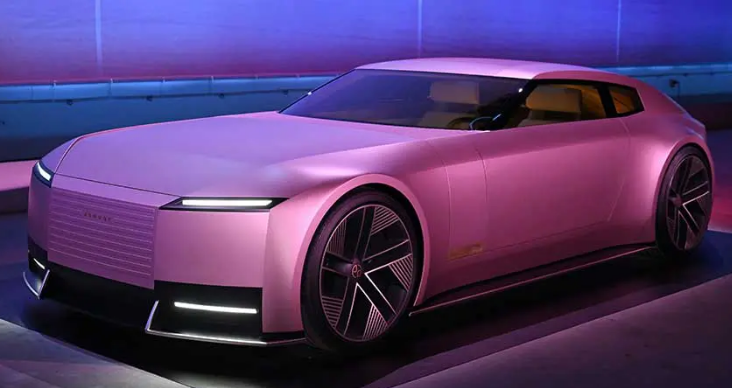
Jaguar is reportedly exploring a potential U-turn on its commitment to become an all-electric car brand, amid concerns over EV demand and lingering backlash to its controversial rebrand.
Sources cited by the Sunday Times say Jaguar has instructed engineers in the UK to investigate a petrol-electric hybrid powertrain that could complement its forthcoming electric models. The move would mark a significant shift from the company’s stated ambition to sell only battery-electric vehicles.
The project is said to centre on a range-extender electric vehicle (REEV), where a small petrol engine serves solely to recharge the battery rather than drive the wheels. Proponents of the technology argue that it can ease “range anxiety” by offering longer total driving distances without depending entirely on charging infrastructure.
The reported development comes after a turbulent period for the marque, which has faced public criticism over its electric-only reboot, a high-profile rebrand, a cyberattack in August, and senior management reshuffles. Last year, Jaguar Land Rover appointed PB Balaji, a Tata Motors executive, as chief executive to steer the brand’s strategic redirection.
Jaguar’s first model under the reboot, a £120,000–£140,000 electric grand tourer, is expected to be unveiled this summer and has recently undergone extreme cold-weather testing near the Arctic Circle. When asked in late 2025 whether Jaguar might reconsider its EV-only strategy, managing director Rawdon Glover insisted the company remained “100 per cent committed to a pure-electric future.” A Jaguar spokesperson reiterated that position, stating: “Our plans to reinvent Jaguar as an electric-only automotive brand are unchanged.”
REEVs have seen uptake in China, where models such as those from Leapmotor can exceed 600 miles of total range. While the technology remains a small portion of global electrified vehicle sales, analysts predict growth in the United States as a transitional step toward full electrification.
In Europe, range-extender vehicles have largely been overlooked since early experiments like the Vauxhall Ampera, launched in 2012. Despite winning European Car of the Year, the Ampera was discontinued in 2015 after weak sales. Current UK regulations allow hybrids and REEVs to be sold for five years beyond the 2030 ban on new petrol and diesel cars, offering manufacturers flexibility as the electric transition accelerates.
If Jaguar were to pursue a range-extender option, it could extend the real-world range beyond the roughly 400 miles projected for its upcoming electric grand tourer, while maintaining an electric-first driving experience.
Jaguar declined to comment directly on reports of hybrid development but reiterated its electric-only ambitions. The speculation underscores the pressure facing premium carmakers as EV demand softens in key markets and consumers weigh practicality against brand ambition in the move to electric mobility.